
By Katy Brewer
Seizures are one of the most common and severe conditions in tuberous sclerosis complex (TSC). Seizures occur when the electrically active cells of the brain, called neurons, fire uncontrollably and produce abnormal electrical activity.
Other brain cells, notably astrocytes, regulate neuronal activity and maintain their surrounding environment. Previous research suggests that astrocytes behave abnormally in TSC and may contribute to seizures.
Researchers generated a 3D model of human brain development called an “organoid”
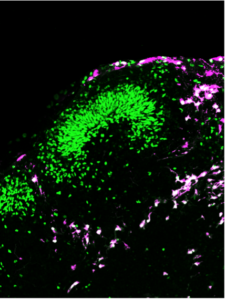
To investigate how loss of the TSC2 gene affects the development of brain cells, a team of researchers led by Dr. Helen Bateup at the University of California, Berkeley, grew human stem cells in 3D to produce tiny balls of brain-like tissue known as organoids. In this environment, stem cells mature in ways that are similar to a human brain in utero.
Starting with stem cells already missing one copy of TSC2, researchers deleted the second copy from a subset of cells (known as TSC2−/− cells) early in organoid growth to generate a mix of cells with one or no working copies of TSC2. This design mimics the “second-hit” mutations in TSC2 arising during fetal development that may trigger the formation of the seizure-associated brain lesions called tubers.
TSC2−/− cells preferentially generated dysfunctional, “reactive” astrocytes
The researchers collected organoids over a 7-month period and analyzed gene expression in individual cells. They found that TSC2−/− cells were more likely to mature into astrocytes instead of neurons. TSC2−/− astrocytes expressed genetic markers associated with disease states, known as “reactive” astrocyte markers. These markers were related to inflammation, tissue remodeling, and astrocytic processes that moderate neuronal firing.
In neurological diseases, reactive astrocytes often appear as a secondary response to problems with neurons or other cells. In this case, TSC2 loss itself caused the astrocytes to become reactive.
mTOR inhibitors partially reversed cellular changes in TSC2−/− astrocytes
TSC1 or TSC2 loss increases the activity of mTOR, a signaling pathway that directs cell growth and function. mTOR inhibitors such as rapamycin or Torin could reverse the effect of TSC2 loss. The researchers found that 7 days of treatment with rapamycin or Torin shifted protein expression in the TSC2−/− astrocytes, partially restoring a normal cell state.
Reactive astrocytes were also observed in patient tuber tissue
Investigators also analyzed 10 tuber samples from patients who underwent epilepsy surgery at Stanford University Medical Center. They found that 9 of the 10 tubers contained a subset of cells with elevated mTOR activity and the same reactive astrocyte features seen in organoids.
These results suggest that even a small population of cells with TSC2 loss could become reactive astrocytes that fail to properly regulate neurons and affect the tissue more broadly. Dr. Bateup’s team is now investigating how abnormal astrocytes may directly cause recurring seizures in individuals with TSC.
Astrocytes may be an alternative therapeutic target for drug-resistant seizures
Although various treatments are available for people with TSC, many still live with drug-resistant seizures, and alternative options are needed. New medicines that modify reactive astrocytes could be effective in these cases, but more research is required to understand which astrocyte functions to target. Furthermore, astrocyte-specific delivery of clinical mTOR inhibitors (such as everolimus) could reduce the adverse systemic effects of oral medications.
Funding
This study was supported by a TSC Alliance Postdoctoral Research Award to Taesun Yoo, with funding also provided by the National Institutes of Health, the American Epilepsy Society, the Chan Zuckerberg Biohub, the California Institute for Regenerative Medicine, the Siebel Stem Cell Center, and the Canadian Institutes of Health Research.
Senior author: Helen S. Bateup, PhD, Professor of Neuroscience and Molecular Therapeutics at University of California, Berkeley (bateup@berkeley.edu).
Katy Brewer, PhD, is an independent medical writer who specializes in neuroscience, metabolism and rare disease biology (katybrewerphd.com).
Help the TSC Alliance accelerate TSC research by donating to the 50 Forward Fund!