
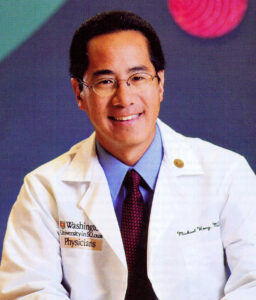
With a career in tuberous sclerosis complex (TSC) spanning more than 20 years, Michael Wong, MD, PhD, has developed personal connections to many individuals with TSC and their families. He takes his work as a physician-scientist very personally. As director of the Washington University Tuberous Sclerosis Center of Excellence in St. Louis, Dr. Wong has gained fresh insights into patient priorities. “You have questions about what needs to be better for the patient. Is it the epilepsy? Is it the medications, or the side effects? You take that back to whatever research you are doing, whether it’s animal models, or clinical research – and try to answer those questions.”
Dr. Wong has a longstanding relationship with the TSC Alliance, which has supported his research. Thanks to that connection, he has been able to receive state funding to expand patient care and research for people in Missouri. More recently, he sits on the board of the Wong Family Foundation, which has recommended funding for the TSC Alliance. Since 2018, The Wong Family Foundation has strongly supported research through the TSC Alliance, including two-year named grants in epilepsy research to promising investigators.
Dr. Wong has helped steer resources to TSC research as a way of giving back to an organization that helped him build his career. “The TSC Alliance is truly an exceptional organization. It’s been very successful in promoting both basic research and clinical trials that have led to the development of a new class of drugs for TSC, the mTOR inhibitors. A lot of that was directly supported by the TSC Alliance.” He also commends the TSC Alliance’s commitment to patient advocacy and education.
With patient care, Dr. Wong has recently focused on the difficulties of individuals with TSC transitioning to adulthood. “Many patients present in childhood, with seizures for example. Pediatric neurologists and other specialists know these patients very well. But since relatively fewer patients get diagnosed as adults, adult specialists do not tend to have as much experience with the disease.” With the extra funding from his state, Dr. Wong was able to establish a multi-specialty clinic for adults with TSC.
In his most recent research, one issue that he says is often unrepresented in TSC studies is sleep disruption. Sleep problems are common in TSC and can have a devastating effect on the quality of life. Using a mouse model of TSC, Dr. Wong’s team was able to replicate a sleep disorder seen in people. They discovered that a neurochemical called orexin can be targeted to improve sleep behavior. Such findings may have implications for other diseases. “The TSC Alliance has done an outstanding job in getting the name tuberous sclerosis complex out there. And this doesn’t just help TSC. What has been found with TSC research has helped other more common diseases, like diabetes, cancer, and epilepsy in general.”
Help the TSC Alliance accelerate TSC research by donating to the 50 Forward Fund!