
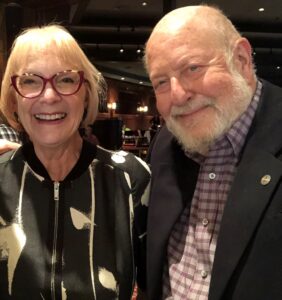
For more than four decades, Dr. Michael Frost and his wife, Janie, have watched the tuberous sclerosis complex (TSC) community grow from a handful of determined families into a global network of researchers, clinicians, and advocates. Along the way, they have given not only their time and expertise, but also their financial support — most recently through the Frost Clinical Research Legacy Fund, created to help advance the future of TSC research. The Frosts have pledged $250,000 to the TSC Alliance’s 50 Forward Fund.
Their connection to TSC began early in Dr. Frost’s medical career as a child neurologist, when he was treating infants with epilepsy in Arizona. “We had a couple of key patients back in Arizona in particular that became more than just patients at the time,” he recalled. “We also ended up being friends.”
One family, in particular, changed the trajectory of his career. Through them, he attended his first national TSC conference and met some of the pioneers in the field, including renowned neurologist Dr. Manuel Rodriguez Gomez. Soon afterward, Dr. Frost moved to Minnesota, where he helped establish one of the country’s first dedicated TSC clinics.
At the time, resources for families were scarce, and TSC was poorly understood. Janie remembers how isolated families often felt. “All that was available were the three moms,” she said, referring to the small group of parents who helped launch what would eventually become the TSC Alliance. “The mother had been crazy trying to figure out, ‘Who can I talk to? What can I do?'”
Janie still remembers attending one of the earliest family conferences in Washington, D.C. “I just stood down there and cried,” she said. “It was just, oh my gosh, this is what it’s all about.”
Over the years, the Frosts watched TSC research evolve dramatically. They saw the discovery of the TSC1 and TSC2 genes, the growth of the Clinical Research Network, and the emergence of treatments that have transformed care for many individuals living with TSC. Dr. Frost became deeply involved in epilepsy research, clinical trials, and national research review panels, while also helping to build databases and tissue banks that continue to fuel scientific discoveries today. He praises the TSC Alliance for accelerating the pace of TSC research. “It’s a model of what rare diseases should be doing.”
For the Frosts, supporting TSC research has an impact beyond just one rare disease. “It’s bigger than just TSC,” Dr. Frost says. “The researchers that are doing it go far beyond just that,” He notes that discoveries in TSC have shaped broader medical advances, from epilepsy treatments to research on dementia and Alzheimer’s disease.
They are encouraged that more research is now focusing on the behavioral aspects of TSC, like TSC-Associated Neuropsychiatric Disorders (TAND). “In many ways, that is more devastating on a daily basis than epilepsy,” says Dr. Frost. “I’m very pleased with the push in research, and also the fact that they’re helping the daily lives of a lot of these people.”
Their decision to establish a legacy fund came from a desire to help sustain that momentum for future generations. “As we were getting older and wanted to leave some sort of legacy,” Dr. Frost says, “the belief in genetics and the tissue bank and supporting it” is central to their giving. Now retired, Dr. Frost often reminisces about his time caring for children with TSC. “I still miss the patients a lot.”
Help the TSC Alliance accelerate TSC research by donating to the 50 Forward Fund!