
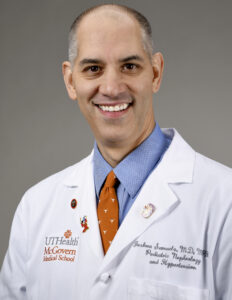
When Dr. Josh Samuels reflects on his career, he doesn’t describe it as a carefully mapped journey. Instead, he sees a series of unexpected opportunities that led him exactly where he was meant to be.
“If you had asked me 25 years ago what I was going to be doing, it’s not this,” he says with a smile. “Looking back, there were stepping stones that got me here. I guess that’s what keeps work fun and interesting.”
Today, Dr. Samuels is a nationally recognized nephrologist at the McGovern Medical School at UTHealth Houston TSC Center of Excellence, where he cares for children and adults living with tuberous sclerosis complex (TSC). For nearly two decades, he has helped families navigate the kidney complications of the disease while witnessing one of the most remarkable periods of scientific progress in TSC history.
His path to TSC began through kidney transplantation. After earning his medical degree from Baylor College of Medicine and completing combined training in internal medicine, pediatrics and nephrology, Dr. Samuels became one of the few physicians specializing in both adult and pediatric kidney care. Early in his career, he gained extensive experience using mTOR inhibitors to care for kidney transplant recipients.
That expertise proved invaluable when researchers discovered that TSC is driven by overactivity of the mTOR pathway.
“When our TSC Center of Excellence was being established, my colleagues asked if I would join the team because I had experience using these medications,” Dr. Samuels recalls. “I really backdoored into tuberous sclerosis complex.”
What began as a professional opportunity quickly became a lifelong passion.
“I came into TSC care right at the cusp of when the research community discovered that mTOR inhibitors could dramatically change the course of this disease,” he says. “You can shrink kidney tumors, decrease seizures, and improve quality of life. The last 20 years have been an incredibly exciting time to care for people with TSC.”
Although he has no family members with the disease, his greatest source of inspiration is those he sees in clinic. “The families and the patients we care for are so involved in their own care and so appreciative of the research that’s been done,” he says. “They have helped us as we have helped them every step of the way.”
Those experiences also shaped his family’s philanthropy.
Following the sale of a family business in 2015, the Samuels family established the Samuels Family Foundation to support causes that reflect their shared values. When the opportunity arose to support the TSC Alliance, Samuels knew the organization was uniquely positioned to make a lasting impact.
“I use the TSC Alliance as a shining example of a disease-specific organization that improves the lives of people with that disease,” he says. “They bring together clinicians, researchers, caregivers and families in a way that I’ve never seen another organization do.”
The foundation chose to support the TSC Alliance’s Reproductive and Perinatal Health Initiative, with Dr. Samuels’ daughter Megan — herself a physician (a pediatric intern) and a member of the foundation’s board — helping evaluate the proposal.
“It has been wonderful seeing the fruit of that donation,” Dr. Samuels says. “The group has done great work.”
As both a physician and a donor, he believes meaningful progress happens through collaboration. When researchers and clinicians share ideas and case studies, and families help inform the future of care, they bring those affected one step closer to living their best lives.
That belief is why he remains so optimistic about the future, “When you talk about being impactful, we try to make gifts that actually move the needle,” he says. “Giving to the TSC Alliance really does move the needle.”
Help the TSC Alliance accelerate TSC research by donating to the 50 Forward Fund!