
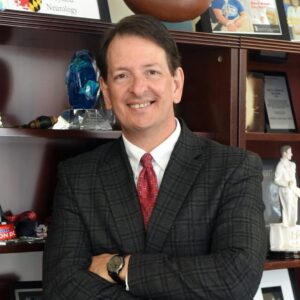
For more than 30 years, Dr. Peter Crino has dedicated his career to improving the lives of people living with tuberous sclerosis complex (TSC). As a physician-scientist, researcher and longtime TSC Alliance leader, he has witnessed extraordinary advances in treatment. But one challenge has remained constant: ensuring that people with TSC continue to receive expert, coordinated care throughout adulthood.
That challenge inspired Dr. Crino to create one of the nation’s first comprehensive adult TSC programs—a model he hopes will one day become the standard across the country.
“I kept hearing the same story from families,” he recalls. “They had wonderful pediatric care, but when their child turned 18, they just fell into the abyss. There simply weren’t places for adults with neurodevelopmental disorders to go.”
As a neurology resident, Dr. Crino examined brain tissue from a patient with TSC following epilepsy surgery. Fascinated by what he saw under the microscope, he began asking questions that would determine the rest of his career.
“I was absolutely captivated,” he says. “That was really my first exposure to TSC.”
After completing his neurology training and epilepsy fellowship at the University of Pennsylvania, Dr. Crino began seeing more adults living with TSC. Recognizing the enormous gap in adult care, he established the first adult TSC clinic at Penn in 1997. Patients traveled from across Pennsylvania, and beyond, because there were so few providers dedicated to adults with TSC.
Over time, his vision expanded beyond TSC to include adults with a wide range of neurodevelopmental disorders. Today, as chair of the Department of Neurology at the University of Maryland School of Medicine, Dr. Crino leads the Clinical Center for Adults with Neurodevelopmental Disorders (CCAND), which includes Maryland’s TSC Center of Excellence. CCAND brings together neurologists, psychiatrists, genetic counselors, nurse practitioners, social workers and other specialists to provide coordinated, lifelong care for adults whose medical needs become increasingly complex with age. “I have patients in their 50s, 60s and even 70s with TSC,” he says. “Adulthood doesn’t stop at age 21.”
To help support the center, Dr. Crino secured a $500,000 annual grant from the state of Maryland. He believes every state should invest in similar programs to ensure families never lose access to expert care after pediatric services end. His vision is for state-supported centers that provide comprehensive care while reducing hospitalizations, improving quality of life and ultimately lowering healthcare costs.
Throughout his career, the TSC Alliance has remained a loyal partner.
His relationship with the organization began more than three decades ago with one of his first research grants from what was then the National Tuberous Sclerosis Association. Since then, he has served as chair of the Scientific Advisory Board, chair of the Program Committee and chair of the TSC Alliance Board of Directors during the COVID-19 pandemic.
“It has been my privilege to serve,” Dr. Crino says. “The Alliance has been my family for my whole career.” Looking back, he is struck by how far the organization has come. “We went from four moms sitting around a kitchen table advocating for an incredibly rare disease to an organization that is teaching other nonprofits how to be effective,” he says.
Dr. Crino credits the TSC Alliance with helping transform scientific discoveries into real treatments. From supporting early research to building clinical trial networks and advocating for FDA-approved therapies, he believes the organization’s impact is unmatched.
“The accomplishments are extraordinary,” he says. “We’ve shown what’s possible when researchers, clinicians, families and advocates work together. That’s the power of the TSC Alliance, and it’s why I continue to support its mission.”
Help the TSC Alliance accelerate TSC research by donating to the 50 Forward Fund!